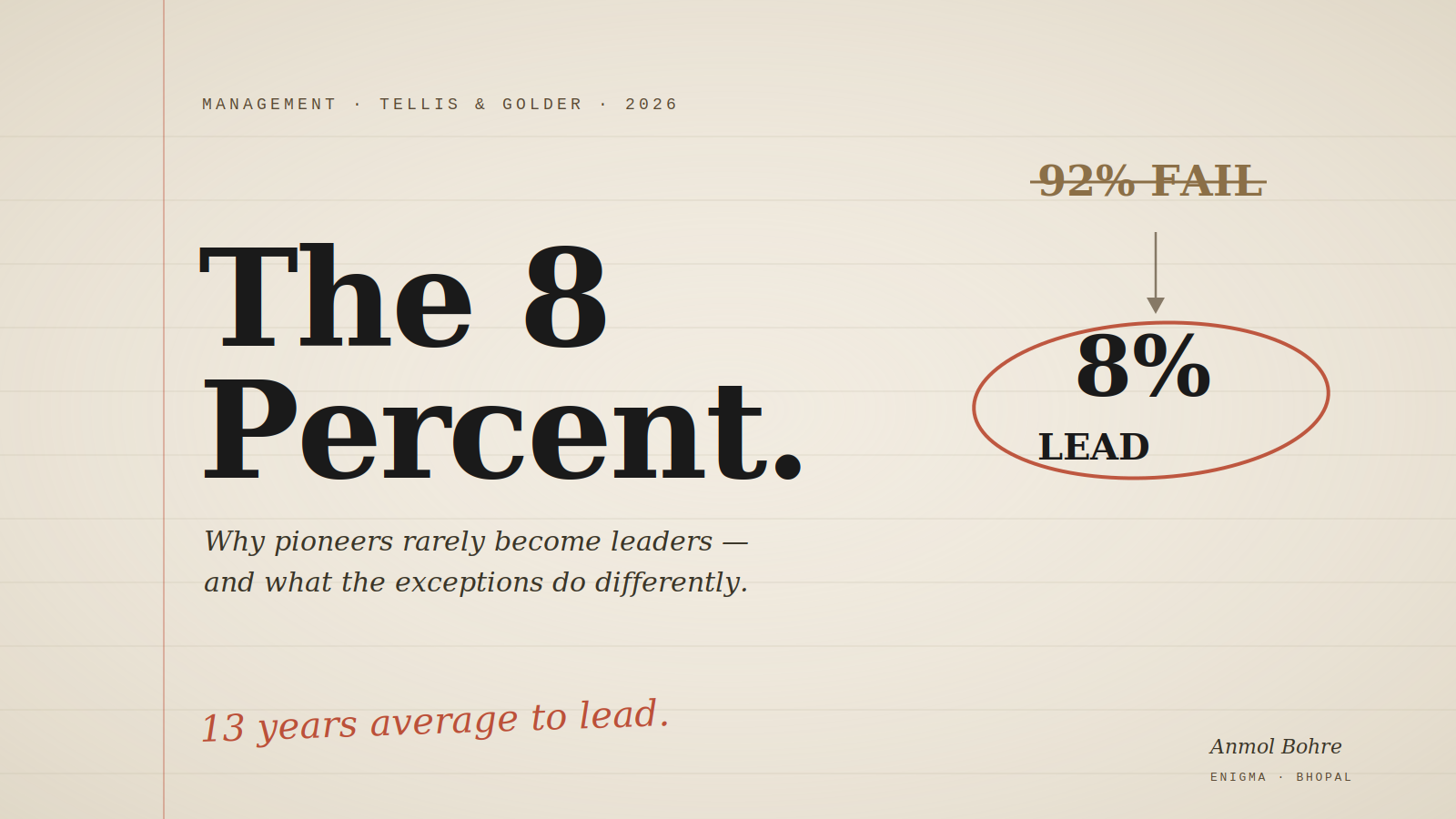
The 8 Percent
A few days ago, I wrote a LinkedIn post pushing back on a comment Rajiv Bajaj made in October 2021. Standing on stage at the Pulsar 250 launch, he called India's electric scooter startups a fad. "Champions eat OATS for breakfast," he said, OATS being Ola, Ather, Tork, and SmartE. He paired it with BET — Bajaj, Enfield, TVS — the legacy "champions." It was clever. It was meant to put us in our place.
My post was an attempt to write back, four and a half years later. I wrote it the way I usually write, which is to say, with one foot in the factory and another in the conviction that the people running the showrooms know things the people writing the reports do not. I named the cohort I belong to — the smaller Indian EV companies that were quietly building this category long before the OATS class arrived. Some of them had strategic or HNI backing. A small handful were genuinely self-funded. Together, this cohort — Hero Electric, Ampere, Okinawa, Tunwal, Enigma, and others — built the early infrastructure, supplier base, and customer trust that the rest of the industry now stands on.
I expected pushback. I got something better.
A series of senior industry voices showed up in the comments, and across six or seven substantive exchanges, they did what good readers do — they took my argument seriously enough to upgrade it. One line in particular has stayed with me. A commenter wrote:
"A powerful reminder that category creators and category leaders are not always the same."
I read that sentence twice. Because what he had done in one line was distil twenty-five years of academic research on first-mover advantage into a single Indian observation. He probably did not know it. I had not fully known it either (I had encountered Tellis and Golder briefly, years ago, in some business article I had long since forgotten). But there is a body of empirical work that says exactly this. And once you understand what it actually found, the entire Indian EV story rearranges itself.
The 8 Percent
In May 1993, two marketing professors — Gerard J. Tellis at USC Marshall and Peter N. Golder at NYU Stern — published a paper in the Journal of Marketing Research with a polite academic title: "Pioneer Advantage: Marketing Logic or Marketing Legend?"
Until that paper, the prevailing belief in business strategy was simple — get to market first, plant your flag, the first mover wins. Decades of MBA case studies, HBS strategy frameworks, and venture capital theses had been built on this idea.
Tellis and Golder did something unusual. They examined approximately 500 brands across 50 product categories using historical analysis — looking not at the companies that survived to be surveyed, but at every company that had entered each category, including the ones that had quietly died. Earlier research had only studied survivors. That was the flaw. The data on first-mover advantage was a bit like surveying people who had won at roulette and concluding the game was easy.
What they found has not been seriously refuted since:
Almost half of all market pioneers — the first companies into a new product category — failed outright.
In only 4 of the 50 categories — 8 percent — was the original pioneer still the long-term market leader.
The actual market leaders, when they emerged, had entered the category on average 13 years after the pioneers.
Let that 13-year number sit. The companies that ended up dominating any given market — Microsoft in browsers, Procter & Gamble in disposable diapers, FedEx in priority airfreight — were not the ones that invented the category. They were the ones that arrived more than a decade later, watched the pioneers struggle, learned the lessons, and then executed at scale.
Tellis and Golder spent the next decade expanding this work into a full book — Will and Vision: How Latecomers Grow to Dominate Markets (2001). The deeper question in that book was not whether pioneers fail — they had proved that — but what the 8 percent do differently.
They identified five factors.
The Five Factors of Enduring Market Leadership
One. Vision of the Mass Market. A radical, uncomfortable conviction that the future customer is the mainstream buyer, not the early adopter. The 8 percent pursued mass markets when their rivals were comfortably serving niches. AOL chased mainstream households when CompuServe and Prodigy targeted technical elites. The early entrants laughed. AOL ate them.
Two. Managerial Persistence. A willingness to grind through years — sometimes decades — of being smaller, less funded, and less respected than rivals. Sony spent over twenty years developing a mass-market video recorder. The 8 percent did not flinch when the cheque ran low or the press cycle turned cold.
Three. Relentless Innovation. A discipline of obsoleting your own products before competitors do. The leaders kept innovating long past comfort, even at the cost of cannibalising existing revenues.
Four. Financial Commitment. The capital endurance to fund the long arc, not just the next quarter. The 8 percent had access to, or built, the financial structure to keep building when the market was unconvinced.
Five. Asset Leverage. A clear-eyed use of existing competencies — manufacturing, distribution, brand, supplier relationships — to dominate adjacent territory rather than restart from zero.
These five factors, refined over a decade of academic research, are the closest thing the field of marketing has to a usable framework for enduring market leadership.
I want to tell you what happened next in my LinkedIn thread.
The Operator Who Independently Arrived at the Same Five
After several days of debate, a senior commenter — clearly someone with decades inside the automotive industry — posted a five-point framework of his own. He had not read Tellis and Golder. He was writing from the factory floor, not the citation index. His list was:
1. Technical focus from top management. R&D calls for investment and time, unlike startups that plan to be in green from day one.
2. Focus on quality.
3. Long-term relationships with suppliers.
4. Investment in people.
5. Treating automotive as automotive only. Not like a food delivery or any other startup.
I read his five and felt a small shock of recognition. Because here was a senior Indian operator, writing in plain language on a phone screen, independently identifying the same five factors that twenty-five years of empirical marketing research had identified.
Look at the parallel:
His "technical focus and R&D" is their relentless innovation.
His "investment in people" is their managerial persistence.
His "long-term supplier relationships" is their asset leverage.
His "R&D calls for investment and time" is their financial commitment.
And his fifth — "treating automotive as automotive, not like food delivery" — is the cleanest one-line translation of Tellis and Golder's vision of the mass market that I have ever read. Because what he was really saying was: stop trying to win this industry with a consumer-tech playbook. Stop optimising for valuation cycles. Optimise for the actual customer — the mainstream Indian commuter who needs the scooter to start in the morning and not break the household budget. That is the mass market. That is the vision. That is the war you are actually in.
Bhai, jab industry ka aadmi aur Harvard ka professor ek hi list bana lete hain, toh us list mein zaroor kuch hai. When the man on the factory floor and the man at the Harvard chair arrive at the same five points, there is something to that list.
The Indian EV Story Through This Frame
Now apply the framework to our industry.
Hero Electric started in 2007. Pioneer. Family-backed (Naveen Munjal branch). Educated the category. Faced ridicule, market indifference, missing infrastructure. Served the early-adopter market for over a decade. Is no longer the leader.
Ampere started in 2008. Pioneer. Backed at various stages by Ratan Tata, Kris Gopalakrishnan, and PE firms. Acquired by Greaves Cotton in 2018 — a hybrid outcome where the founder, Hemalatha Annamalai, built the category and a strategic incumbent then absorbed it.
Ather Energy started in 2013. Pioneer in the premium, technology-forward segment. And — uniquely — appears to be successfully transitioning from category creator to category leader. The number-three position, the refusal of a further Hero MotoCorp stake increase, the disciplined product-led brand building, the steady financials without PLI benefit — this is what Tellis and Golder's research would call "the 8 percent profile." Ather may be the rare Indian case where the pioneer and the leader are the same company. They deserve every bit of the credit being directed at them.
Okinawa, Tunwal, Enigma started 2015 onwards. A second wave of believers, with very different capital structures. Okinawa raised across multiple rounds from an HNI/family-office base. Tunwal and Enigma built largely on their own balance sheets. All three came in when the early infrastructure was in place but the customer was still uncertain. We were not the pioneers; we were not yet the leaders. We were the second cohort of pioneers — the ones who built dealer networks, localised supply chains, debugged service economics, and shaped the mass-market product. Some in this cohort are thriving. Some have struggled with quality issues. Some are quietly profitable and rarely discussed.
The OATS cohort that Rajiv Bajaj mocked in 2021 — Ola, Ather, Tork, SmartE — were the well-funded pioneers, the visible face of the category to outsiders. Three of those four have either collapsed, stalled, or pivoted away from their original promise. Ather, the exception, is the one running the 8 percent playbook.
The legacy giants — Bajaj, Hero MotoCorp, TVS — entered late. Bajaj launched the Chetak EV in January 2020. Hero launched Vida in 2022. They are currently leading the sales table. Bajaj Chetak is the best-selling electric scooter in India. Hero Vida just had its best fiscal year. TVS iQube is in the top three monthly. They are, in Tellis and Golder's framework, exactly the kind of late entrants who tend to win — established asset bases, financial endurance, distribution networks, brand recognition. They are well-positioned to be the 13-year-late winners the research predicts.
But here is the important point that LinkedIn keeps missing. Currently leading the sales table is not the same as having won the category. The Indian EV two-wheeler market is, depending on how you count, somewhere between six and nineteen years old. The Tellis-Golder framework studies enduring market leadership over 25-to-50-year arcs. To declare a category winner six years into the mainstream phase is the same intellectual mistake as declaring the 1971 war over in May. The geometry was still being decided.
That is the actual story of the Indian EV two-wheeler industry. Not "incumbents always win." Not "small founders were right." A more honest reading: a category was built by waves of pioneers, most of whom will not lead it. A few might. The legacy incumbents are currently winning the sales table and are well-positioned to consolidate that into long-term leadership. But the category is six years into its mainstream phase, not thirty. The next decade decides whether the legacy giants harden their lead into enduring market leadership, or whether one of the pioneers — including us — executes the five factors and breaks the pattern. The war is not over. The geometry is still being decided.
Where Enigma Sits, Honestly
I have been running an electric vehicle factory in Bhopal for ten years. Enigma started in electric three-wheelers in 2015 and pivoted to two-wheelers in 2019. We are not a household name. We do not have OATS-class venture capital, nor BET-class legacy distribution. We did not raise institutional capital from Tata, Infosys founders, or PE firms the way Ampere did. We did not have HNI rounds the way Okinawa did. We built the company on our own balance sheet — the smaller, harder, less-glamorous version of being a pioneer in this industry. That is the precise sub-cohort Enigma sits in: the self-funded Indian EV pioneers.
The question is not whether we are in the 8 percent today. It is whether we are running the playbook the 8 percent ran. So let me be honest, both about what I think we have built and about what remains open.
On managerial persistence — eleven years in electric mobility, two-segment pivot survived, founder still on the factory floor. I will claim this one.
On asset leverage — roughly 80 percent localisation, in-house R&D, supplier relationships built over years. I will claim this one too.
On vision of the mass market — we have always built for the mainstream Indian commuter, not the urban early adopter. The price point, the service network design, the warranty structure — all aimed at the Tier-2 and Tier-3 customer. I will claim this one.
On relentless innovation — partially. The next product cycle, the next chemistry transition, the next form factor — these are the tests still ahead. I am not going to claim a factor that the work has not yet earned.
On financial commitment — the most open question of all. The fundraise that is currently in progress is part of the answer, not the answer itself. The 8 percent did not win because they raised one big round. They won because they had the financial structure to keep building for fifteen, twenty, thirty years. Whether Enigma has that arc is something the next decade will judge, not the next quarter.
I do not know if Enigma will be the exception. Nobody who is in the 8 percent knew either, until decades later. What I know is that the five things that separate them from the rest are the five things we have been quietly building toward since 2015. Whether the universe rewards that discipline with leadership is not entirely up to me.
The discipline itself is the only honest version of running this company.
The thread that produced this essay is, in its way, a small miracle of Indian LinkedIn. A controversial post, a respectful debate, multiple senior industry voices, real learning on every side. It reminded me that the best founder communication is not the post you write. It is the conversation that grows around it.
The point was never the throne. The point was always what you believe in.
Onwards and upwards.


All information is subject to specific conditions | Copyright © 2021 Enigma Electric All rights reserved.


